

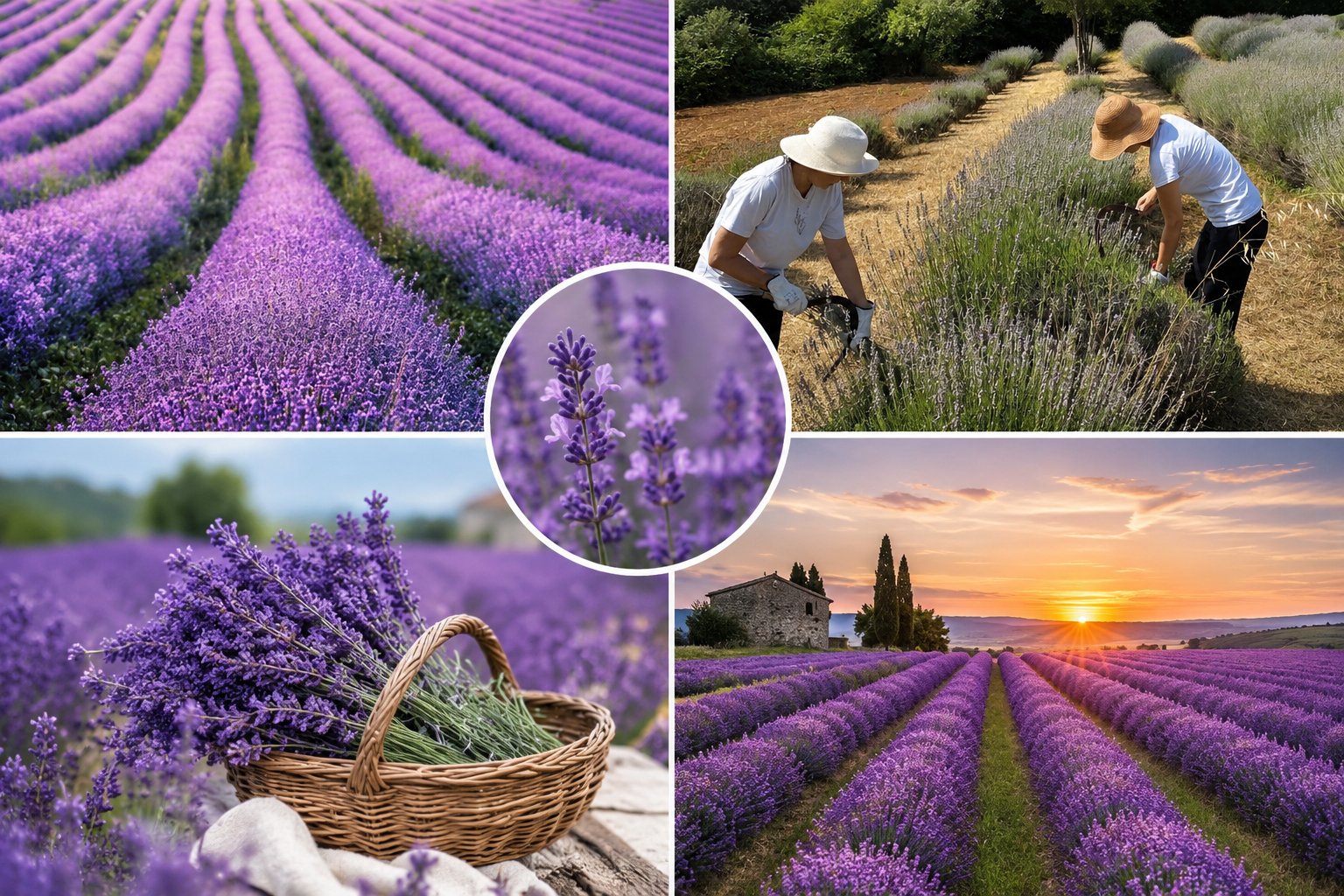
How to preserve the memory of a wonderful summer, travels, and new friends? You can buy ordinary souvenirs, or you can bring lavender flowers from different places and create your own Lavender Summer at home that lasts all 12 months.
Join my Telegram channel for more recipes, lavender tips, and fragrant inspirations: whisperlavanda
So, let’s create a fragrant garden together within the walls of the city.
1. How to Properly Harvest Lavender for Drying
For the lavender to dry well, retain its color and strong aroma, it is important to harvest it at the right time and in the right way.
When to harvest (the most important!)
- Best time: when the lavender has just started blooming or is in full bloom, but no later than when half of the flowers have opened.
- Time of day: in the morning, after the dew has dried, but before the strong heat (ideally 8–11 am).
- South of France: we start harvesting now (July) — the most suitable period.
- In most regions of Italy, lavender is harvested in June and July.
- In Russia, the timing varies greatly by region, but generally by mid-July you can still harvest almost everywhere. Central Russia — late July – early August (if the lavender has time to bloom well).
Readiness sign: the inflorescences are bright purple, the buds have already opened but have not yet started to fall. If lavender is grown for essential oil, harvesting is done when about 50–70% of the flowers are open.
2. How to Cut Correctly
- Use sharp scissors or secateurs.
- Cut the stems 10–15 cm below the start of the inflorescence (leave a long stem — it’s more convenient for drying).
- Do not pull the plant out by the roots!
- Collect in small bunches immediately or put in a basket/box.
- It is better not to use plastic bags — moisture may accumulate.
3. Useful Tips
Harvest in dry weather. After rain, wait at least 1–2 days. Do not harvest faded lavender (gray or brown flowers) — the aroma will be weak.
For lavandin, the rules are the same, but it is usually more resilient.
The best and gentlest method is natural air drying.
STEP-BY-STEP INSTRUCTIONS FOR DRYING LAVENDER AT HOME
Preparing the Bunches
Divide the stems into small bunches (10–25 pieces each). Do not make thick bunches — mold may form inside due to poor ventilation.
Remove the lower leaves from the stems (about 5–10 cm) so they do not rot.
Tie the bunches at the base with strong thread, an elastic band, or twine. An elastic band is convenient — it tightens as it dries.
Drying (main method)
Hang the bunches upside down in a dry, dark or semi-dark place with good ventilation.
Ideal places: attic, shed, ventilated pantry, balcony (without direct sun), under a canopy.
Important: no direct sunlight — the flowers fade strongly and lose their aroma. Preferred temperature: 20–28°C, low humidity.
Drying Time
Usually 7–14 days, depending on air humidity and bunch thickness.
Lavandin (hybrid) often dries a little faster and yields more essential oil.
How to Know It Is Dry
The flowers should easily crumble with light rubbing. The stems should break with a characteristic crunch, not bend.
Alternative Drying Methods
- On a net / paper: spread the stems in a single layer on a net, gauze, or paper in a well-ventilated place. Turn 1–2 times a day.
- In the oven: at a temperature not higher than 40°C with the door ajar (very long and not the best option).
- In an electric dehydrator: 35–38°C, 4–8 hours. The fastest method.
Useful Tips
- Do not dry in the bathroom or kitchen — too much humidity.
- If the air is very humid, you can turn on a fan or dehumidifier nearby.
Storage Rules
To preserve the aroma and color for as long as possible (1 to 3 years), it is important to protect it from light, moisture, and heat.
- Completely dry lavender is the main thing. If any flowers remain damp — mold will quickly appear.
- Separate the flowers from the stems — it is more convenient to store and use.
- Store in a dark place (cabinet, drawer, pantry). Light is the main enemy.
- Cool place. In summer, it is better not to leave it in the kitchen or on the balcony — too hot. Ideal: 15–22°C.
- Airtight, but not overly compressed. Glass jars with screw lids are the best choice.
- Do not store near strongly scented products (coffee, spices, tea) — lavender absorbs odors.
Best Storage Methods:
| Storage Method | Duration | Advantages | Disadvantages | Recommendation |
|---|---|---|---|---|
| Glass jars | 2–3 years | Preserves scent well | Must be kept in the dark | Excellent option |
| Paper bags | 1–1.5 years | Breathable, lower mold risk | Scent fades faster | Good |
| Fabric sachets | 8–12 months | Can be used immediately | Loses scent faster | For wardrobes |
| Metal boxes | 1.5–2 years | Protects from light | May “suffocate” | Acceptable |
Useful Tips:
- If making large stocks — divide into several small jars. This way, when opening one, the others do not lose their aroma.
- Check every few months for mold or insects.
- For sachets in linen closets, use cotton or linen bags.
- If you want to preserve maximum aroma — store whole inflorescences, do not grind them in advance.
And may lavender become your companion even on autumn and winter days, reminding you of the languid summer and its joys.
Your Whisper of Flower





Great content! Keep up the good work!