
Tonight is the Full Moon. And it seems to me the perfect moment to open a book,
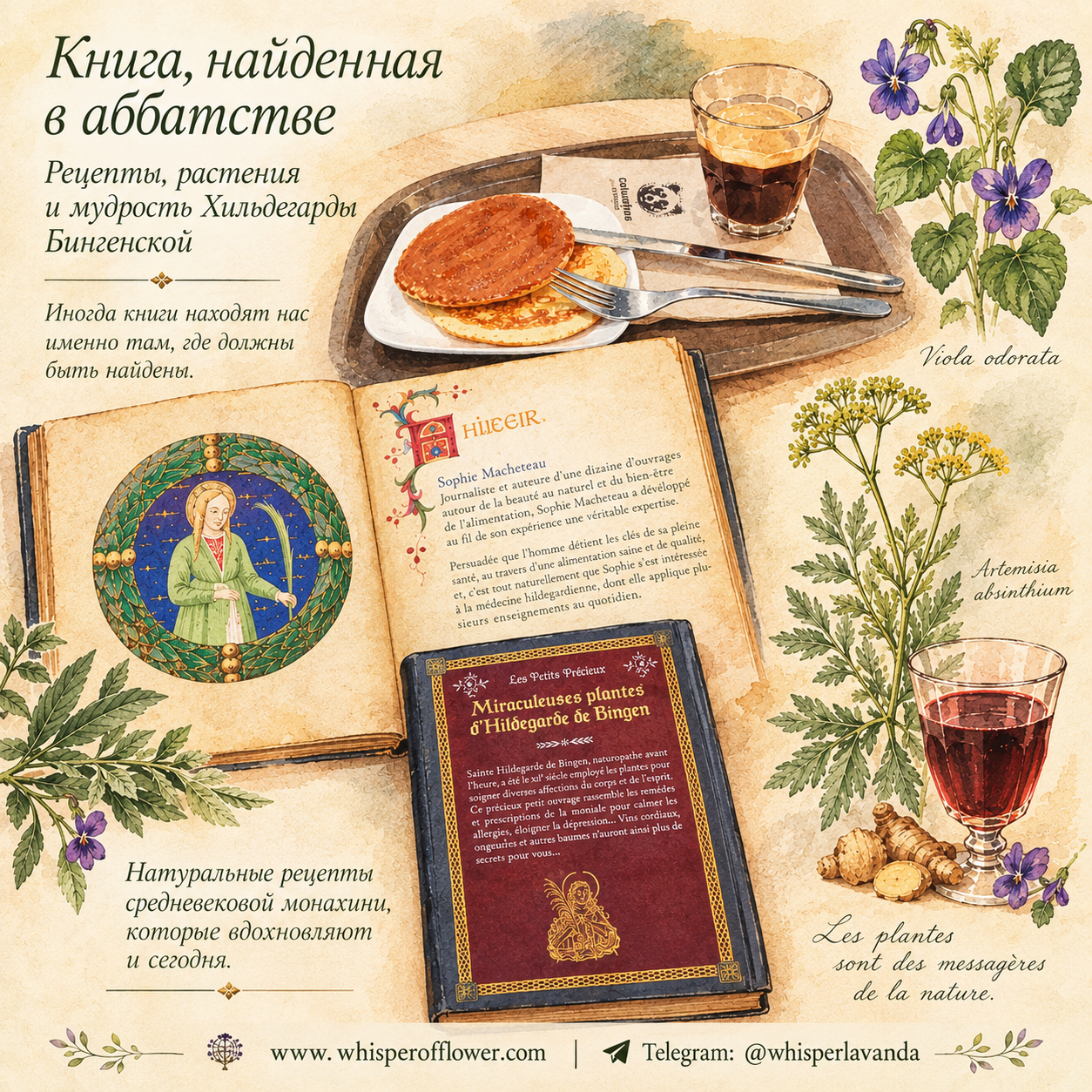
Tonight is the Full Moon. And it seems to me the perfect moment to open a book, Miraculous Plants of Hildegard of Bingen (Rustica, 2017), devoted to Hildegard of Bingen, whom many consider one of the great pioneering figures of European naturopathy.
Hildegard of Bingen lived in the 12th century. She was born in Germany in 1098 and died in 1179. A Benedictine nun, abbess, writer and composer, she left behind an extraordinary legacy in which spirituality, observation of nature and knowledge of plants are constantly intertwined.
I bought this book of Hildegard’s recipes and advice this summer at Thoronet Abbey, in Provence.
The place enchanted me: powerful, spiritual and at the same time deeply earthly, it is a moving guardian of the memory of French history. Once, Prosper Mérimée — among other things, a great admirer of Pushkin — helped save the abbey from destruction when he was Inspector General of Historical Monuments. Since then, misfortune seems to have spared this abbey, whose doors are still open to visitors and musicians. Hildegard herself never lived at Thoronet: her monasteries were located in Germany, along the banks of the Rhine. But almost nine centuries later, her writings about plants came into my hands here, in the silence of an ancient Provençal abbey.
I opened the book at random and came across one of the most famous wine recipes attributed to Hildegard:
The Famous Cordial Wine
Ingredients:
- 10 sprigs of fresh parsley with their leaves
- 1 bottle of wine, white or red
- 1 tablespoon of wine vinegar
- 3 tablespoons of honey
Preparation:
Pour the wine into a saucepan and add the vinegar, honey and parsley. Heat for about 5 minutes, then pour into a bottle and seal.
In Hildegard’s tradition, there is an entire world of Kräuterweine — herbal wines to which various beneficial properties were attributed.
For example:
Veilchenwein — Violet Wine for Melancholy
One version of the recipe calls for:
- 15 g of violet herb or flowers
- ½ litre of white wine
- 5 g of galangal powder
- 5 g of liquorice powder
The violet is cooked in the wine; galangal and liquorice are then added. The preparation is left to rest overnight, then gently reheated and strained.
Over time, the violet has revealed itself to be far more complex than its delicate beauty might suggest. Its composition includes flavonoids, anthocyanins, salicylates, phenolic compounds and even particular plant peptides known as cyclotides. Some of these substances have demonstrated antioxidant, anti-inflammatory and neuroprotective activity in experimental studies.
Perhaps this is why the ancient ideas associating violet with the emotional state of a human being seem particularly intriguing to us today — even though modern science does not confirm the medieval medical concepts concerning the treatment of “melancholy.”
Hildegard and the Rhythm of Nature
Hildegard lived according to the rhythm of nature. She observed the changing seasons, the movement of the stars and the cycles of the Moon, seeing the human being as part of a much larger natural order.
According to her vision, plants also had their own rhythm and their own moment: the right time to gather them, dry them and use them.
Her works Physica and Causae et Curae became important sources of medieval knowledge about plants, food and health.
In 2012, Pope Benedict XVI proclaimed Hildegard a Doctor of the Church.
A special place in her legacy belongs to the plant world.
In Physica, Hildegard describes numerous plants and their properties, from aloe to lavender. For this reason, she is often regarded as one of the important figures who preceded the European traditions of herbalism and naturopathy.
The book contains a wonderful section, Hildegard’s Hortus Medicus — her “medicinal garden” — bringing together plants to which she attributed different properties.
Almost nine centuries later, some of her observations can seem surprisingly contemporary.
Lavender is associated today with relaxation and anxiety reduction; fennel has a long tradition of use in supporting digestion; sage is traditionally used for the throat and mouth; and ginger is well known for its traditional use against nausea.
Of course, Hildegard’s medieval explanations are very different from those of contemporary science.
But there is something fascinating in her writings: she observed nature closely and trusted in its ability to accompany and support the human being.
Perhaps this is why, when we open her book today, we sometimes feel that the distance between us and this woman who lived almost nine centuries ago is not so great after all.
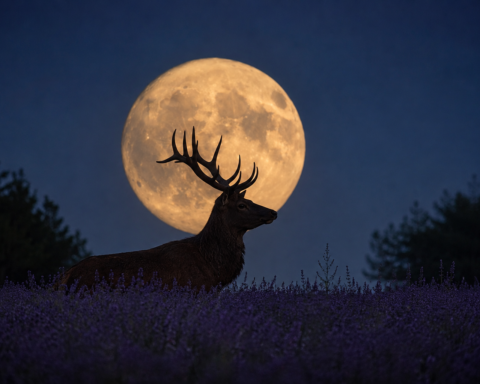
She gathered plants in the monastery garden in the distant 12th century.And yet, it is said that on moonlit nights, true lovers of nature might still catch a glimpse of her luminous figure and the hem of her long robe somewhere in a garden…
I am drawn to the idea of looking at plants not merely as collections of active compounds, but as part of a much larger picture: nature, the seasons, the rhythms of the human being and the world around us.
And so, tonight, I open my book to the pages devoted to Hildegard’s plants.
The Full Moon is a beautiful excuse to slow down, light a candle, breathe in the scent of herbs and listen a little more carefully to what is happening within us. 🌿🌕